0 $0.00
items in your cartto quote Checkout
Ooops no items were found.
Try something else.
Ok
Loading…

Plumbing Valves vs. Industrial Valves: Design, Types, and Core Differences

3 min
Whether you are shutting off water under a kitchen sink or controlling superheated steam in a power plant, valves perform the same fundamental job: starting, stopping, or regulating fluid flow. However, putting a standard residential plumbing valve in a chemical refinery, or vice versa, could cause either immediate catastrophic failure or absurd cost overruns.
While plumbing and industrial valves operate on similar mechanical principles, their design standards, material selection, operational tolerances, and actuation mechanisms belong to entirely different engineering classes.
 

1. Design & Engineering Philosophy

The primary difference between plumbing and industrial valves comes down to the operating environment and the consequences of failure.

Plumbing Valves: Efficiency & Code Compliance

Plumbing valves are designed for commercial and residential potable water, drainage, and low-pressure gas lines.
  • Operating Conditions: Pressures rarely exceed 125 PSI, with temperatures usually staying between ambient outdoor levels and water heater maximums (~140°F / 60°C).
  • Primary Focus: Cost-efficiency, compact size, long-term non-toxicity (e.g., NSF/ANSI 61 lead-free brass standards), and ease of manual operation by non-technical users.
  • Connections: Standard threaded (NPT), solder/sweat, compression, or press-fit ends.

Industrial Valves: Extreme Reliability & Process Control

Industrial valves control harsh chemicals, volatile hydrocarbons, high-pressure steam (and low-pressure steam), and abrasive slurries in oil refineries, power plants, and pharmaceutical facilities.
  • Operating Conditions: Pressures can range from vacuum conditions up to 10,000+ PSI, with temperatures spanning cryogenic levels (-320°F / -195°C) up to severe heat exceeding 1,000°F (538°C).
  • Primary Focus: Zero leak tolerances (API 598 / ISO 5208 standards), resistance to thermal shock, erosion, and chemical corrosion, and full integration with automated process control networks.
  • Connections: Standard threaded (NPT), Flanged (ANSI/ASME B16.5), socket-weld, butt-weld, or high-pressure union ends.

2. Common Valve Types Across Both Domains

Both sectors utilize similar mechanical configurations.

Ball Valves

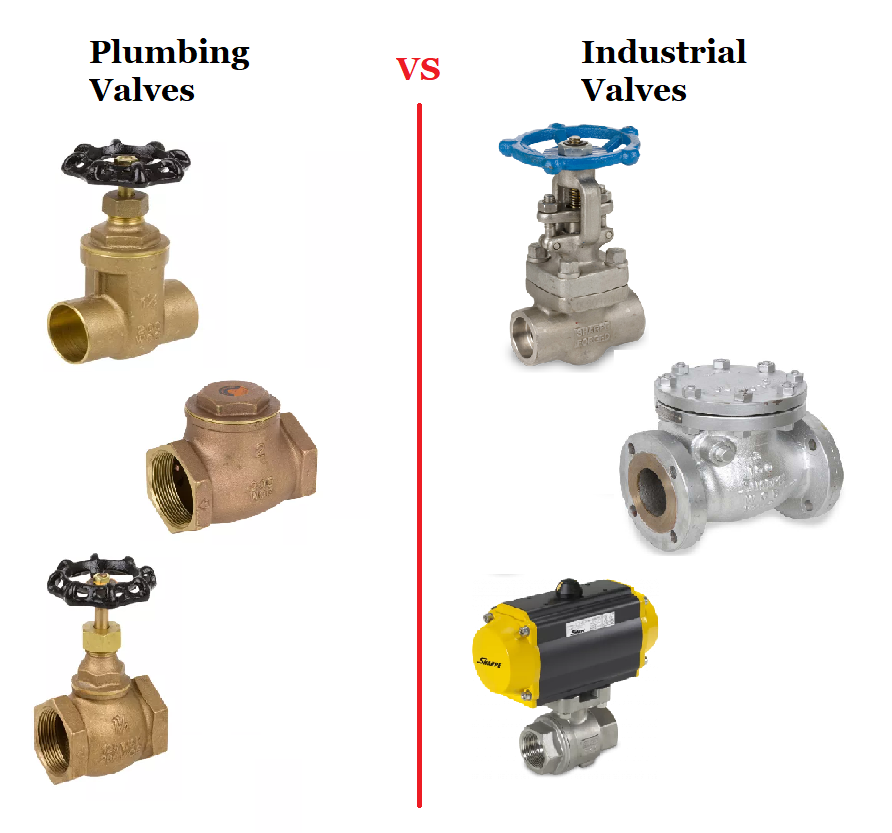
  • Plumbing: Single-piece or two-piece forged brass or PVC bodies with PTFE seats. Used primarily as main shutoff valves or under-sink isolation valves.
  • Industrial: Two-piece or three-piece (top-entry / split-body) forged carbon steel or 316 stainless steel bodies. Some feature metal-to-metal seating, trunnion-mounted balls for high torque control, or fire-safe testing (API 607).

Gate & Globe Valves

  • Plumbing: Light-duty brass gate valves used for full-flow shutoff where operation is infrequent. Globe valves are used sparingly for basic flow throttling (e.g., outdoor hose bibbs).
  • Industrial: Heavy cast steel or alloy gate valves designed for isolation of high-pressure pipelines. Industrial globe valves feature precision-guided stems and custom plug geometries for fine linear flow control.

Check Valves

  • Plumbing: Simple swing or spring-check valves made of bronze or plastic, designed to prevent backflow into municipal water systems.
  • Industrial: Dual-plate wafer checks, piston checks, or non-slam tilting disc check valves rated to prevent severe water hammer damage in high-velocity industrial networks.

3. Key Differences at a Glance

Feature / Aspect Plumbing Valves Industrial Valves
Primary Materials
Lead-free brass, bronze, PVC, CPVC
Bronze, Carbon Steel, Stainless Steel
Pressure Ratings
125–300 WOG (Water, Oil, Gas)
Class 150 to Class 2500
Temperature Range
32°F to 180°F (0°C to 82°C) -320°F to 1,500°F (-195°C to 815°C)
Actuation & Control
Manual levers, handwheels, or basic solenoids
Manual, Pneumatic, hydraulic, or electric actuators
Serviceability
Throwaway / replaced entirely upon failure Fully field-serviceable (replaceable packing, seats, and trims)
Governance & Standards
NSF/ANSI 61, UPC, IPC ASME B16.34, API, ISO, MSS-SP

4. Actuation and Automation

Residential plumbing typically uses manual operation. A user turns a handle or quarter-turn lever when maintenance is needed.
In industrial settings, valves are active components of automated control loops. Industrial valves often use pneumatic actuators, electric motors, or electro-hydraulic positioners. Guided by a central Distributed Control System (DCS) or PLC, these automated valves modulate position to fractions of a millimeter, dynamically regulating flow rates, temperature, and line pressure without human intervention.

Conclusion

While both plumbing and industrial valves manage fluids, their design paths diverge based on risk and environment. Plumbing valves prioritize safety, affordability, and simple manual control for drinking water systems. Industrial valves are heavy-duty, field-serviceable instruments built to survive extreme pressure, temperature, and corrosive media where valve failure is not an option.
 
SEARCH ×

Search